What should I check before tapping Declare in Rummy?
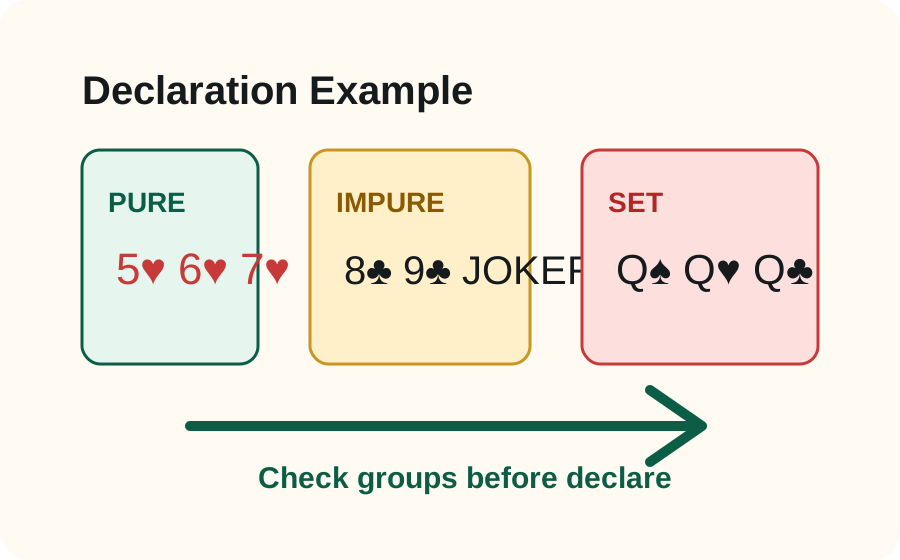
Direct Answer
Before tapping Declare, I check four things: one pure sequence, another valid sequence or set, correct joker placement, and no loose card pretending to belong somewhere. If I am unsure, I wait one more turn instead of risking an invalid declaration.
My Player Check
The Declare button always feels exciting, especially when the hand looks neat. I have learned to slow down for ten seconds. I read the groups from left to right and ask whether each group would make sense to another player. If I cannot explain the grouping, I do not declare.
Many invalid declarations happen because the player focuses on the final card they just picked and forgets the whole hand. A good final-card draw can still leave one broken group. Mobile screens make this easier to miss because cards are close together and auto-sort can move them in a way that feels valid without being valid.
Detailed Explanation
A careful declaration check starts with the pure sequence. Then confirm whether the rules require a second sequence, whether sets use different suits, and whether jokers are placed only where they are allowed. Next, look for duplicate suits inside a set, gaps inside a sequence, and cards that are visually near a group but not actually part of it. If the app offers a validation hint, use it, but do not ignore the written rules. Some tables apply different point penalties for invalid declaration, so the cost of a rushed tap can be higher than one extra discard.
When I write this kind of answer, I try to separate three things: what the app or source actually shows, what a player can verify on the phone, and what is still only a claim. That makes the page more useful than a short yes-or-no answer. It also avoids the risky habit of saying an app is safe, legal, or reliable everywhere when the real answer depends on source, state, account status, KYC, app version and current terms.
Example
If my hand has 6-7-8 of diamonds, 10-Joker-Q of spades, 4-4-4 of different suits and one extra King, I am not done unless that King is placed into a valid group or discarded before declaration. The first group may be pure, the second may be impure, the third may be a set, but one loose card can still spoil the declaration.
Risks and What to Check
The main risk is penalty points or losing a hand that could have been saved. There is also a learning risk: if I blame the app instead of checking my groups, I repeat the same mistake. I always check the table rules, especially around drop, joker, printed joker and declaration order.
- Check the official source or store listing before trusting a download link.
- Compare package name, app version, update date and permissions before opening the app.
- Read KYC, withdrawal, bonus and state restriction terms before depositing or playing for prizes.
- Keep screenshots of errors, transaction IDs and support replies if the issue involves money or account access.
What I Would Do Next
I would create a personal pre-declare routine: pure sequence, second group, sets, loose cards, rule hint. I would use that routine even on practice tables so it becomes automatic when the game is faster.
Related Questions
- 13 Card Rummy Declaration Examples for Beginners
- What is a valid declaration in Rummy?
- What does drop mean in Rummy?
FAQ
Is it better to declare quickly?
Speed matters less than validity. A rushed invalid declaration can cost more than taking one careful extra turn.
Can auto-sort guarantee a valid hand?
No. Auto-sort helps arrange cards, but the player should still verify every group against the rules.